
Seattle Knob-and-Tube Cost Guide
Knob-and-Tube Replacement Cost in Seattle
Clear planning ranges for Seattle homeowners comparing knob-and-tube replacement, partial rewiring, whole-home rewiring, panel add-ons, permits, inspections, and wall-access costs.
Benchmark Home Services helps Seattle homeowners budget for active knob-and-tube replacement after inspection reports, insurance requests, remodel discoveries, two-prong outlets, attic insulation concerns, plaster-wall access issues, and older-home electrical upgrades.
Call (206) 717-5076 for your FREE estimate. If you have an inspection report, panel photo, attic photo, or insurance request, send it before the visit so we can start with better context.
Fast answer: Seattle knob-and-tube replacement commonly ranges from about $4,500 for targeted work to $35,000+ for larger whole-home replacement. Complex projects with plaster access, panel replacement, service upgrades, or broader modernization can reach $45,000+.
What changes the price?
K&T pricing is not only about square footage. The cost depends on what is still active, how hard it is to reach, and whether the project also needs panel, grounding, permit, or finish-repair planning.
- ✓ Active vs. abandoned knob-and-tube wiring
- ✓ Attic, crawlspace, plaster, and finished-wall access
- ✓ Panel condition, grounding, AFCI/GFCI, and circuit layout
- ✓ Permits, inspections, documentation, and bid comparison
See What Homeowners Are Saying
Real reviews help Seattle homeowners compare electricians with more confidence. Look for feedback about clear explanations, older-home electrical work, rewiring, panel planning, troubleshooting, and how the estimate process was handled.
If you are pricing knob-and-tube replacement in Seattle, the first question is not simply “how many square feet is the home?” The better question is: how much active legacy wiring still serves the home, and what has to happen to replace it correctly?
Some homes have a limited run of active K&T feeding one area. Others have old wiring mixed with remodel-era wiring, ungrounded outlets, unfinished attic runs, finished basements, plaster walls, outdated panels, or service-capacity limitations. Those conditions change the cost and the right scope.
This guide supports Benchmark’s main knob-and-tube replacement in Seattle page. Use it to understand planning ranges, quote variables, likely exclusions, and the questions to ask before approving a K&T replacement estimate.
- Targeted replacement may work when active K&T is limited to a room, circuit, attic run, fixture path, or inspection concern.
- Larger partial replacement may make sense when several rooms or circuits are affected, but the whole home does not need to be rewired at once.
- Whole-home replacement or rewiring may be the better long-term plan when active legacy wiring is widespread or tied into a broader outdated system.
- Panel or service upgrades can change the budget when the existing equipment cannot support a clean modern circuit layout.
Short Answer
What does knob-and-tube replacement cost in Seattle?
In Seattle, knob-and-tube replacement commonly ranges from about $4,500 to $12,000+ for targeted work, $12,000 to $25,000+ for larger partial replacement, and $25,000 to $35,000+ for many whole-home K&T replacement projects.
More complex projects can reach $35,000 to $45,000+ when the scope includes plaster or finished-wall access, panel replacement, service upgrade planning, extensive grounding or outlet improvements, difficult routing, or broader house rewiring.
These are planning ranges, not a fixed quote. A real estimate depends on what is active, what is accessible, what must be replaced, and what is included or excluded.
Visual Cost Guide
Knob-and-Tube Rewiring Cost Guide
This infographic gives homeowners a quick visual overview of the main cost tiers, common access-hole planning, and the factors that can move a Seattle knob-and-tube replacement project up or down in price.
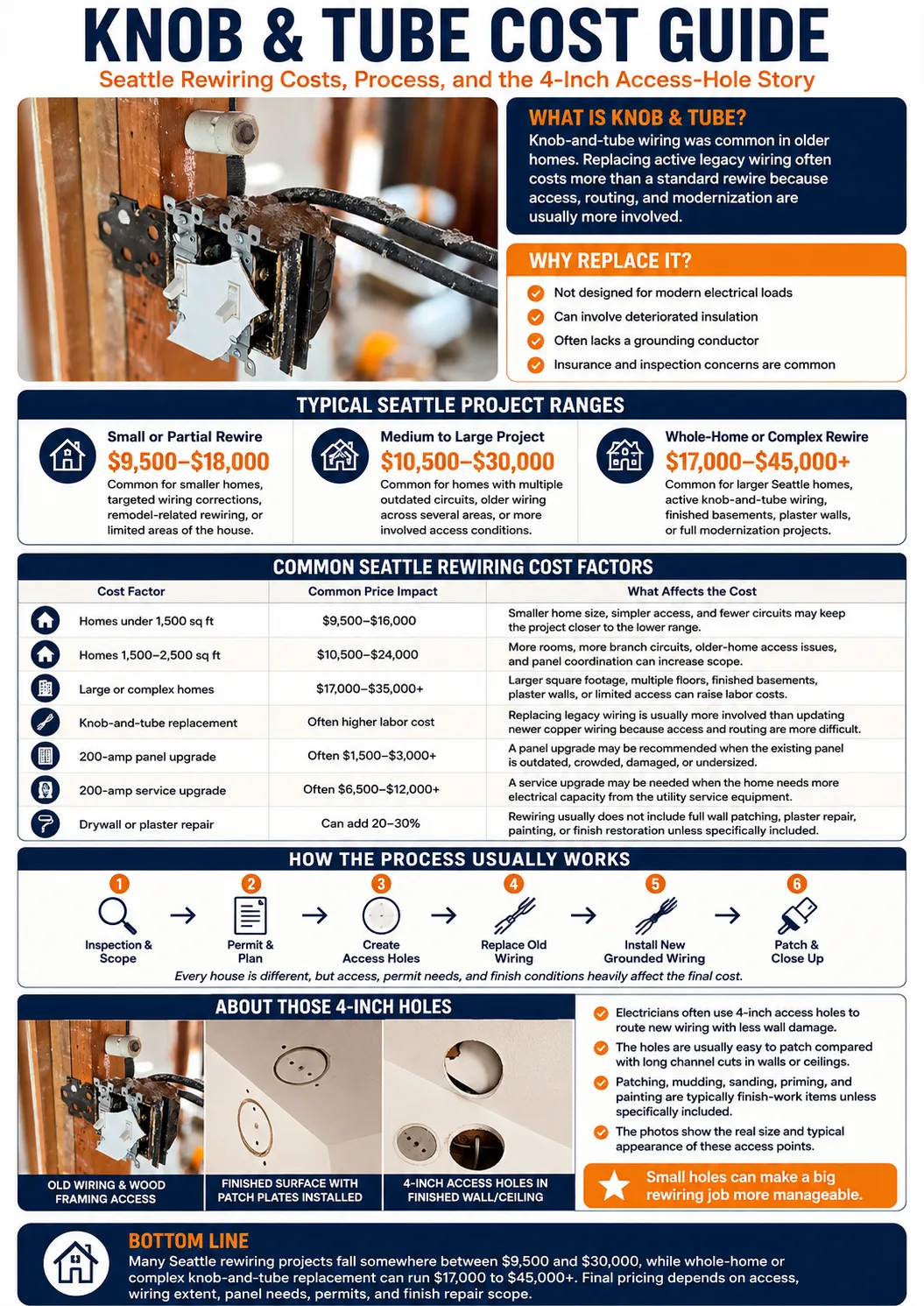
Seattle Knob-and-Tube Replacement Cost Ranges
Use these ranges for budgeting and bid comparison. The right scope should be based on a licensed electrician’s evaluation of active wiring, access conditions, panel capacity, grounding, permit needs, and project goals.
Targeted K&T Replacement
$4,500–$12,000+
Common when active knob-and-tube wiring is limited to a smaller area, such as one room group, lighting run, attic section, bedroom area, inspection finding, or remodel-discovered circuit.
Larger Partial Replacement
$12,000–$25,000+
Common when multiple rooms, ceiling fixtures, outlet runs, attic/basement routes, or older mixed circuits need replacement, but the home does not require a full rewiring scope.
Whole-Home K&T Replacement
$25,000–$35,000+
Common when active legacy wiring is widespread and the better plan is to replace original branch wiring throughout much of the home with safer modern wiring and better circuit organization.
Complex Rewire + Panel or Service Work
$35,000–$45,000+
Possible when K&T replacement is part of a broader modernization project involving panel replacement, service-capacity work, plaster-wall access, finished basements, added circuits, or future-load planning.
Cost Drivers
Why Seattle K&T Estimates Vary So Much
Seattle’s older homes are rarely identical. A Ballard craftsman with an unfinished attic, a Queen Anne home with plaster walls, a Wallingford bungalow with mixed remodel wiring, and a West Seattle home with a finished basement can all require different wiring routes, access points, permit timing, and restoration planning.
The most reliable estimates explain the actual conditions found in the home, not just a generic per-square-foot number.
How much active wiring remains
Visible ceramic knobs or tubes do not always prove the wiring is active. The price changes when the electrician maps which circuits still serve lights, outlets, rooms, or concealed areas.
Access through attic, basement, or walls
Open attic and basement routes can reduce disruption. Finished ceilings, tight crawlspaces, built-ins, finished basements, and plaster walls usually increase planning time and labor.
Panel condition and breaker space
New branch circuits need a panel that can support a clean layout. If the existing panel is outdated, crowded, damaged, poorly labeled, or undersized, panel replacement may need to be discussed.
Service capacity and future loads
Some K&T projects connect to larger planning around EV charging, heat pumps, induction cooking, remodels, home offices, or ADU/DADU work. That can make service upgrade planning part of the conversation.
Grounding, AFCI, and GFCI planning
Replacement wiring often triggers decisions about grounded outlets, AFCI protection, GFCI protection, circuit layout, device locations, and panel compatibility. These choices affect both safety and cost.
Wall repair and finish exclusions
Electrical work may require access holes. Drywall, plaster, painting, texture matching, trim work, or finish restoration may be excluded unless the estimate clearly says otherwise.
Permits and Inspections
Do Seattle K&T Projects Need Permits?
Major knob-and-tube replacement and rewiring work typically requires an electrical permit. The Seattle Department of Construction & Inspections explains that an electrical permit is needed when wiring is installed, altered, extended, or connected to electrical equipment.
SDCI also explains that most electrical permits require cover, service, and final inspections. That matters for budgeting because wiring cannot be covered before required inspection approval when a cover inspection applies.
Review the official SDCI electrical permit page and SDCI electrical inspections page for city guidance. Benchmark handles permit-aware planning for Seattle residential electrical work.
Insulation Warning
Can Insulation Change the Scope?
Yes. Attic insulation, remodel insulation, and weatherization planning can change the urgency and scope of a knob-and-tube project. Do not cover suspected active K&T wiring without proper electrical review.
Washington’s concealed knob-and-tube wiring rule is specific about insulation conditions, licensed electrical contractor survey/certification, inspection of repairs or alterations, and overcurrent protection. The rule also states that foam insulation may not be used with knob-and-tube wiring.
Review WAC 296-46B-394 and ask Benchmark to evaluate the wiring before insulation, attic work, or remodel work moves forward.
What Should Be Included in a K&T Estimate?
A low number is not useful if the scope is vague. A strong estimate should explain what was inspected, what is active, what will be replaced, what is excluded, and what could change once work begins.
Ask what is included
- How active knob-and-tube wiring was identified or mapped
- Which rooms, circuits, fixtures, and areas are included
- Whether permits and required inspections are included
- Whether new devices, boxes, circuit labeling, and documentation are included
- Whether panel work, breakers, AFCI/GFCI, grounding, or bonding corrections are included
- Whether the estimate includes a completion summary for inspection, insurance, buyer, or seller questions
Ask what is excluded
- Drywall repair, plaster repair, painting, texture matching, or trim work
- Unexpected hidden wiring, unsafe splices, damaged conductors, or previously unreported remodel wiring
- Panel replacement, service upgrade, meter work, or utility coordination if not named
- Fixture replacement, lighting layout changes, extra outlets, or unrelated circuit additions
- Insulation contractor work, attic remediation, or finished-space restoration
- Insurance underwriting guarantees, lender guarantees, or promises outside the electrician’s control
Targeted vs. Whole-Home
Is Partial Knob-and-Tube Replacement Cheaper?
It can be, but only when the wiring is truly limited and the remaining system can be left in a safe, explainable condition. Partial replacement is not a shortcut for a home with widespread active legacy wiring, dangerous splices, overloaded circuits, insurance deadlines, or remodel work that exposes a larger issue.
1. Identify the trigger
The trigger may be a home inspection, insurance letter, remodel discovery, two-prong outlet concern, attic insulation project, flickering light, dead outlet, or visible K&T in an unfinished space.
2. Determine what appears active
Active wiring changes the scope. Abandoned wiring may still need documentation, but it is not the same as energized wiring still serving outlets, lights, switches, or rooms.
3. Compare scope options
Benchmark can explain whether the home is a candidate for targeted replacement, larger partial rewiring, or a more complete house rewiring plan.
4. Build the estimate around reality
The estimate should explain access points, permit assumptions, panel assumptions, exclusions, schedule expectations, and documentation so you know what you are approving.
Preparing for an Estimate
What to Send Before You Request Pricing
Better information helps avoid vague pricing. You do not need to diagnose the wiring yourself, but photos and documents can help Benchmark understand the likely trigger before the visit.
- Home inspection report pages mentioning knob-and-tube, old wiring, ungrounded outlets, open splices, or electrical safety concerns
- Insurance company, buyer, seller, lender, or Realtor request language
- Photos of the main electrical panel, breaker labels, meter area, and nearby wall space
- Photos of visible ceramic knobs, ceramic tubes, old cloth wiring, attic wiring, basement wiring, crawlspace wiring, or two-prong outlets
- Project trigger: buying, selling, insuring, remodeling, insulating, troubleshooting, or planning a larger electrical upgrade
- Timeline pressure, such as closing date, insurance deadline, remodel schedule, or planned insulation work
Need a broader older-home plan?
K&T replacement often connects to other older-home electrical decisions. If you are not sure where to start, use the older Seattle home electrical upgrade guide.
For bid comparison, see the Seattle house rewire quote guide. For general service pricing, see electrician cost in Seattle.
If the panel may be part of the project, review Seattle electrical panel readiness before the estimate.
How Benchmark Helps You Compare K&T Bids
Benchmark’s goal is not to make every old-home project sound the same. The goal is to explain the difference between a small correction, a partial replacement, and a larger electrical modernization plan.
We separate active from abandoned
The estimate should not treat every visible old wire as the same thing. We help you understand what appears active, what appears abandoned, and what still needs further evaluation.
We explain panel assumptions
If the panel affects the replacement plan, we explain why. If panel work is not included, that should also be clear before you compare numbers.
We clarify wall access
K&T replacement may require openings. We plan wire routes carefully and explain likely access needs before work begins so finish repair does not become a surprise.
We document the outcome
Completion documentation can help with inspection report follow-up, buyer questions, insurance requests, and future electrical planning. We do not guarantee underwriting decisions.
Knob-and-Tube Cost FAQ
These answers are designed for Seattle homeowners budgeting for old wiring replacement, comparing estimates, or deciding whether K&T replacement should be part of a larger rewiring plan.
What is the average cost to replace knob-and-tube wiring in Seattle?
Seattle K&T replacement commonly ranges from about $4,500 for targeted work to $35,000+ for larger whole-home replacement. Complex projects with plaster access, panel replacement, service upgrades, or broader modernization can reach $45,000+.
Why is there such a wide cost range?
The range is wide because the price depends on how much wiring is active, how accessible it is, how many circuits or rooms are affected, whether the panel can support new circuits, permit and inspection needs, and whether wall repair is included.
Can knob-and-tube wiring be partially replaced?
Sometimes. Partial replacement may be appropriate when active K&T is limited to specific areas. If the wiring is widespread, modified, buried, or tied into other outdated wiring, broader replacement may be the better long-term option.
Does knob-and-tube replacement require a permit in Seattle?
Major K&T replacement and rewiring work typically requires an electrical permit. Depending on the scope, inspections may include cover, service, feeder, or final inspection steps.
Are drywall, plaster, and painting included?
Not automatically. Electrical estimates often exclude drywall, plaster, texture, paint, trim, or finish restoration unless those items are specifically included. Ask every bidder to state what finish repair is included or excluded.
Can a panel upgrade change the cost?
Yes. Many older homes with active K&T also have older panels, limited breaker space, grounding concerns, or service-capacity limitations. If the panel must be replaced or reorganized, the total project cost can increase.
Will insurance cover a home with knob-and-tube wiring?
Some carriers may decline coverage, increase premiums, limit coverage, request documentation, or require proof that active K&T has been replaced or decommissioned. Benchmark can document completed electrical work, but we do not guarantee underwriting decisions.
Can I add insulation before replacing K&T?
Do not cover suspected active K&T without electrical review. Washington rules for existing concealed knob-and-tube wiring and insulation are specific, and foam insulation may not be used with knob-and-tube wiring.
How long does knob-and-tube replacement take?
Many projects take several days to two weeks once scheduled, but larger or more complex jobs can take longer. Permit timing, inspections, access, wall conditions, panel work, and finish repair coordination can affect the total schedule.
What should I send before requesting an estimate?
Send inspection report language, insurance requests, panel photos, visible wiring photos, attic or basement photos, known room concerns, remodel plans, and timeline pressure. Better information helps Benchmark build a better evaluation path.
Ready to Price Knob-and-Tube Replacement?
Benchmark Home Services helps Seattle homeowners evaluate active legacy wiring, compare replacement scopes, plan around permits and inspections, and understand how K&T replacement connects to rewiring, panels, grounding, insurance, inspections, and older-home upgrades.
Call (206) 717-5076 or request an estimate online. If you have an inspection report, panel photo, visible wiring photo, or insurance request, include it with your message.